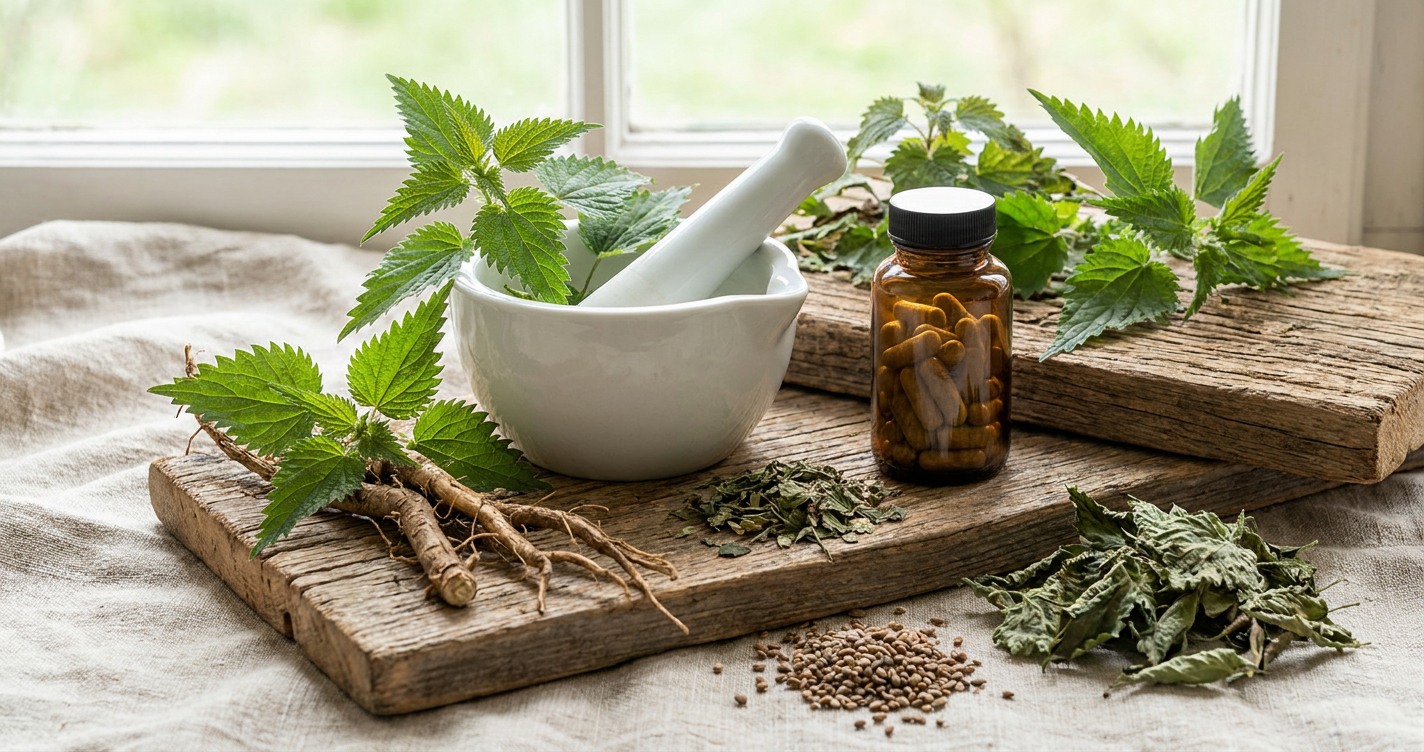
Stinging nettle — Urtica dioica — is one of the more interesting herbs in the men’s health supplement space. Unlike most testosterone ingredients that try to increase production or reduce aromatization, stinging nettle works primarily through sex hormone-binding globulin (SHBG). This is a different mechanism that makes it complementary to other ingredients rather than redundant.
SHBG is a protein produced by the liver that binds to testosterone and estrogen in the bloodstream. When testosterone is bound to SHBG, it is biologically inactive — it cannot bind to androgen receptors and deliver its anabolic signals. Free testosterone is what matters for muscle, libido, energy, and all the outcomes men care about.
Stinging nettle root appears to reduce SHBG binding, which means more free testosterone is available.
How It Works
The primary mechanism is not fully established, but the evidence points to several relevant actions:
SHBG binding reduction. The active compounds in nettle root (including scopoletin and lignans) appear to bind to SHBG in a way that reduces its affinity for testosterone. This is the most relevant mechanism for testosterone optimization — more free T, same total T.
5-alpha-reductase inhibition. Like saw palmetto, nettle root has some 5-alpha-reductase inhibiting activity, reducing the conversion of testosterone to DHT. Nettle root’s inhibition is weaker than saw palmetto’s.
Aromatase modulation. Some evidence that nettle root modulates aromatase activity, reducing the conversion of testosterone to estrogen. The effect appears modest.
These three mechanisms together — reduced SHBG binding, modest DHT inhibition, modest estrogen reduction — make stinging nettle a multi-pathway ingredient.
The Research
Human clinical evidence is limited but supportive.
A 2005 study in Phytomedicine examined men with BPH taking 300mg of nettle root extract twice daily for 8 weeks. The treatment group showed significant improvements in IPSS and quality of life. Serum testosterone was unchanged, but free testosterone indices improved — consistent with SHBG modulation.
A 2004 study in Planta Medica found that nettle root extract inhibited the binding of DHT to SHBG in vitro. This supports the proposed SHBG mechanism.
A 2000 study compared saw palmetto and nettle root combination against finasteride in men with BPH. The combination showed comparable symptom improvement with fewer side effects.
For testosterone specifically: evidence that nettle root raises total testosterone is weak. Evidence that it improves free testosterone via SHBG modulation is more plausible.
Who Benefits
Stinging nettle root is most relevant for:
- Men with high SHBG — SHBG increases with age. If your SHBG is high (above 50 nmol/L), nettle root’s SHBG-binding mechanism is more relevant.
- Men with BPH symptoms — the prostate health evidence is more established.
- Men on a testosterone stack — nettle root works differently from zinc, tongkat ali, and ashwagandha, providing more complete coverage.
For young men with normal SHBG, nettle root is less likely to produce noticeable benefits.
Dosing
Studies used 300mg of nettle root extract twice daily (600mg total). The root extract is used, not the leaf. Standardized extracts typically contain a minimum of 0.8% beta-sitosterol.
Stinging Nettle and Testosil
Testosil does not contain stinging nettle root. If you want to add it for its SHBG-modulating effect, 600mg daily split into two doses is the studied protocol. It pairs well with saw palmetto for combined SHBG and 5-alpha-reductase coverage.
The Bottom Line
Stinging nettle root is not a primary testosterone booster. Its most interesting mechanism is SHBG modulation — reducing the binding of testosterone so more is free and available. This is a genuinely different pathway from most other ingredients.
For men with elevated SHBG, nettle root is one of the few herbal options that addresses this directly. For men with BPH, the evidence is more established. For young men with normal SHBG and normal hormone levels, the benefits are likely minimal.
The best use of nettle root is as part of a layered supplement protocol — not as a standalone testosterone solution, but as one component addressing a specific mechanism (SHBG) that other ingredients miss.