The relationship between exercise and testosterone is one of the most well-documented in all of sports medicine. Unlike supplements, where the evidence is often mixed and the effect sizes are small, the data on resistance training and testosterone is consistent and meaningful.
But not all training is equal. The type, intensity, volume, and recovery structure of your training determines whether you are helping or hurting your testosterone levels.
Here is what the research shows.
The Acute Response
Acute heavy resistance exercise produces a short-term testosterone spike. This is well-documented. A heavy session of compound movements — squats, deadlifts, bench press, rows — will raise testosterone levels significantly in the hour following training. This is a normal physiological response to the metabolic stress of intense muscular work.
The magnitude of the spike depends on the intensity and volume of the session. Heavier loads (1-5 rep range) and higher overall volume tend to produce larger acute testosterone responses. This is one reason heavy compound movements are foundational to any training program aimed at hormone optimization.
However — and this is important — the acute spike is temporary. Testosterone returns to baseline within 24-48 hours in most individuals. The spike itself is not what produces long-term testosterone benefits. The adaptation comes from the chronic, repeated exposure to training stress over months and years.
The Chronic Adaptation
This is where the real benefit lies. Long-term resistance training is associated with consistently higher baseline testosterone levels compared to sedentary individuals. Multiple cross-sectional studies have shown that resistance-trained men have higher average testosterone than age-matched sedentary controls.
The mechanism is not entirely understood, but several factors are likely involved:
1. Increased muscle mass. More muscle mass is associated with better insulin sensitivity, lower body fat, and improved metabolic health — all of which are associated with higher testosterone. Adipose tissue converts testosterone to estrogen via aromatase. Less body fat means less estrogen conversion and a more favorable testosterone-to-estrogen ratio.
2. Improved neuromuscular function. Heavy resistance training improves the efficiency of the hypothalamus-pituitary-gonadal axis (HPGA). The nervous system becomes better at signaling for testosterone production in response to training stress.
3. Hormonal milieu. The repeated acute testosterone spikes from training sessions, over time, may condition the HPGA to maintain a higher baseline set point.
Heavy Compound Movements vs. Isolation
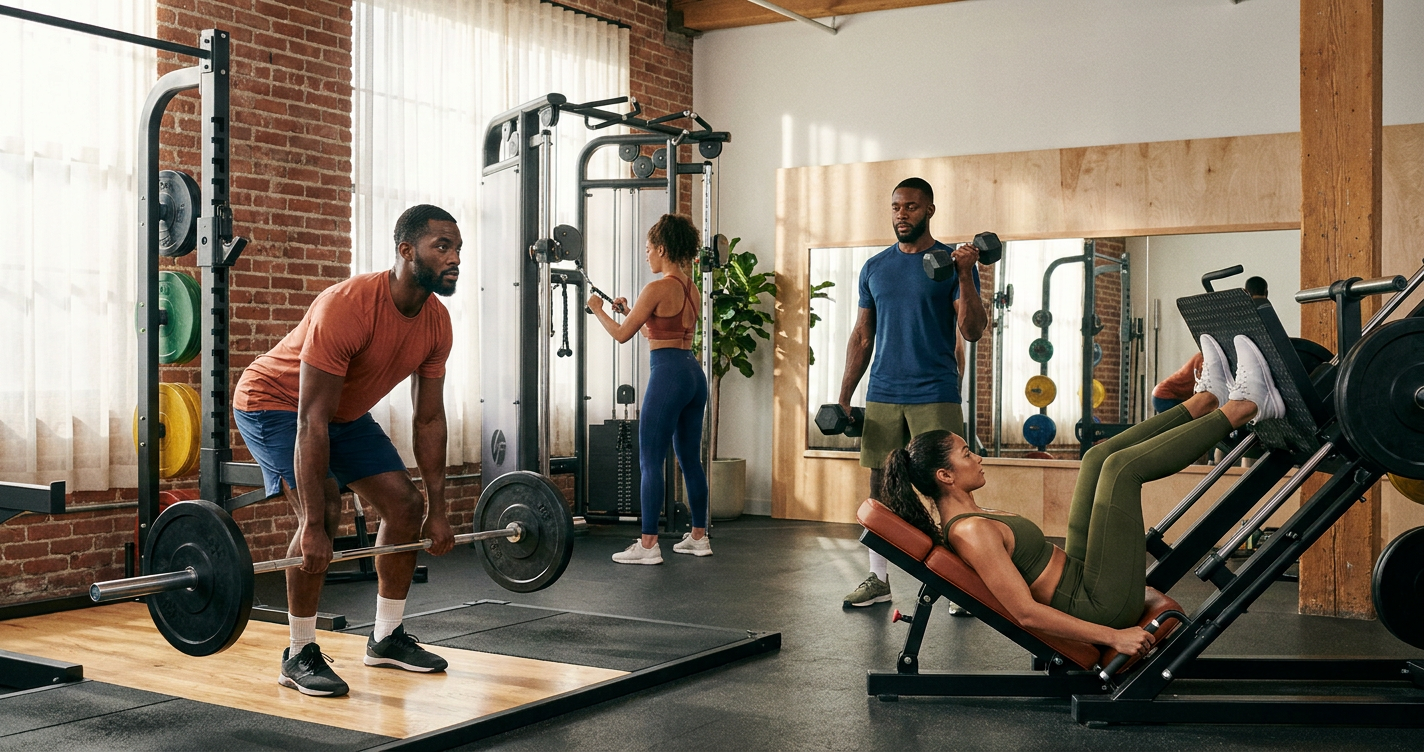
The research consistently shows that multi-joint compound movements produce larger testosterone responses than isolation exercises. The big three — squat, deadlift, and bench press — dominate the studies on acute testosterone response to resistance training.
The proposed mechanism: compound movements recruit more muscle mass, produce greater metabolic stress, and require more CNS output than isolation work. The greater overall physiological demand produces a larger hormonal response.
This does not mean isolation work is useless — it means that if you are training specifically for testosterone optimization, your program should be built around compound movements with isolation work as accessory work, not the other way around.
Training Frequency and Volume
Two factors that are often overlooked in the testosterone-training conversation: frequency and volume.
Training frequency: Training the same muscle group too frequently — before it has fully recovered — can chronically elevate cortisol and suppress testosterone. The research suggests that 48-72 hours between training the same muscle group is optimal for hormonal adaptation. Overtraining, even without feeling is overtrained, is will suppress testosterone.
Training volume: There is a curvilinear relationship between training volume and testosterone response. Low volume produces minimal stimulus. Moderate volume produces an optimal response. Excessive volume (high sets, excessive frequency, too many exercises per session) produces an excessive cortisol response that can suppress testosterone.
The practical sweet spot: 3-5 compounds per session, 3-4 sessions per week, with 48-72 hours between sessions targeting the same muscle groups. Most people who have low testosterone from training are overtraining, not undertraining.
Intensity and Progressive Overload
Heavier loads (80-95% of 1RM) produce larger acute testosterone responses than lighter loads (60-70% 1RM) matched for total volume. This finding is consistent across multiple studies.
The practical implication: to maximize the testosterone response to training, include heavy singles, doubles, and triples in your program. The 3-5 rep range on compound movements is particularly effective for hormonal adaptation.
This is different from the common bodybuilding approach of moderate weights and high reps. For hormone optimization specifically, the heavier end of the spectrum is superior.
Cardio and Testosterone
Here is where the research gets more nuanced. Chronic excessive cardio — long-duration steady-state endurance training — can suppress testosterone. Marathon runners and cyclists often have lower testosterone than age-matched resistance trainers.
The proposed mechanism: chronic cardio elevates cortisol, increases SHBG, and can suppress the HPGA when it becomes excessive. The body interprets repeated prolonged endurance stress as a signal that the environment is hostile and reproduction is not a priority.
Moderate cardio — defined as 2-3 sessions per week of 30-45 minutes — does not appear to harm testosterone. The problem is chronic high-volume endurance training without adequate recovery.
For men who want to optimize testosterone: do not let cardio dominate your program. Resistance training is the foundation. Add cardio for cardiovascular health, but keep it in the moderate range and do not let it interfere with recovery from your lifting.
Recovery Is Where the Adaptation Happens
Training provides the stimulus. Recovery is where the hormonal adaptation occurs. Without adequate recovery — sleep, nutrition, stress management — the testosterone response to training is blunted.
Sleep is the most important recovery factor. Testosterone production peaks during deep sleep. Studies show that even a single night of sleep deprivation reduces testosterone by 10-15% in young men. Chronic sleep restriction has a cumulative effect.
The practical recommendation: 7-9 hours of sleep per night, with deep sleep prioritized. If you are training hard and sleeping poorly, you are undercutting your hormonal adaptation.
Who Should Be Careful
For most men, structured resistance training increases testosterone. However, there are exceptions:
- Men with existing low testosterone — heavy training can be an additional stress if not properly managed. Start with moderate loads and build gradually.
- Men over 50 — recovery capacity is reduced. Overtraining is more likely and more damaging to hormonal health.
- Men who are already overtrained — adding more training will not fix low testosterone caused by excessive training stress. Fix the recovery deficit first.
Resistance Training and Testosil
Testosil is a supplement stack. It does not interfere with the testosterone benefits of resistance training — in fact, the combination may be synergistic. Training provides the hormonal stimulus, Testosil supports the body is own production pathways.
Taking Testosil while training is the practical approach for men who want to combine supplementation with the most evidence-based testosterone optimization strategy available.
The Bottom Line
Resistance training is one of the most effective natural interventions for testosterone optimization. Not all training is equal — heavy compound movements, moderate volume, adequate recovery, and progressive overload are the key variables.
Build your program around squats, deadlifts, rows, and bench press. Keep volume moderate. Train 3-4 times per week. Prioritize sleep. Do not let cardio dominate.
This is the approach that the evidence supports, and it is free. Supplements, including Testosil, can complement the training effect — but no supplement replaces the hormonal stimulus of heavy compound training.