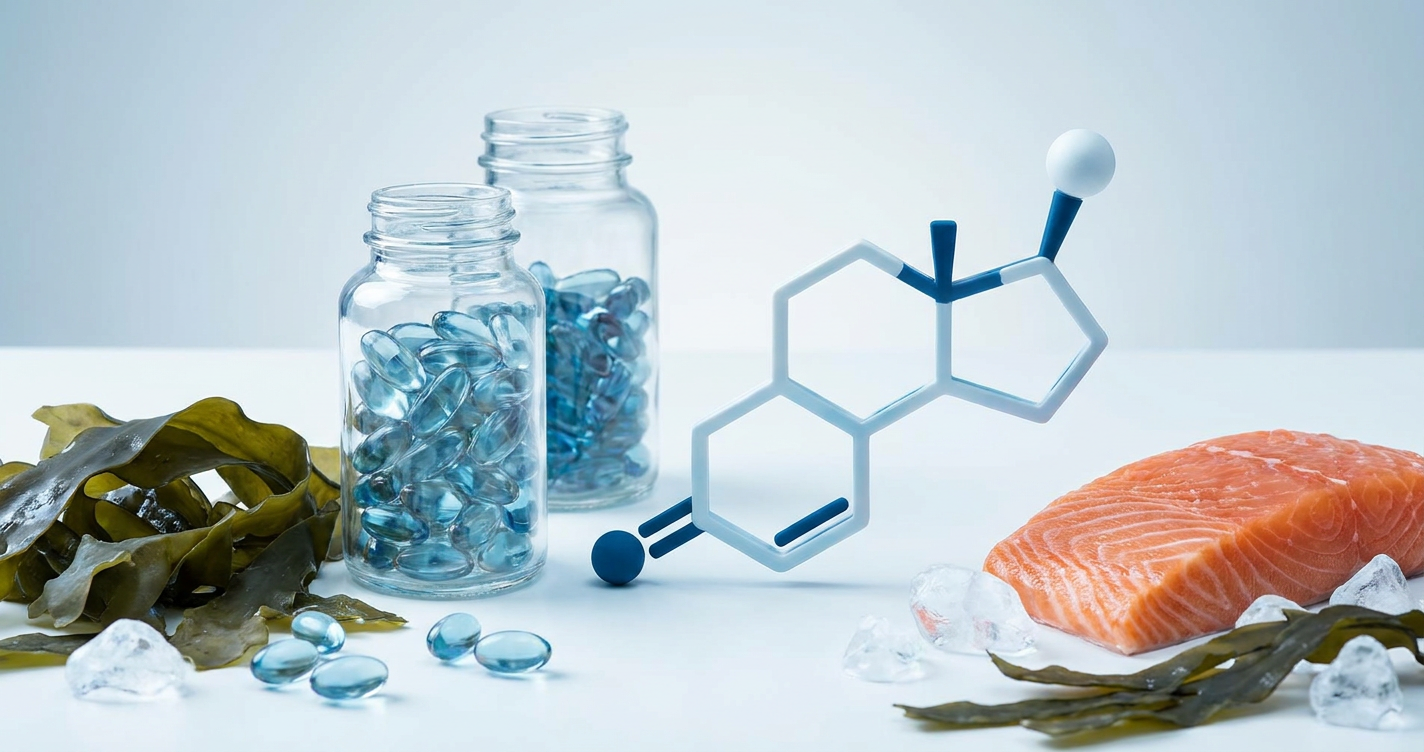
Fish oil is one of those supplements that everyone takes, often without knowing exactly why. It has broad cardiovascular and anti-inflammatory benefits. The relationship with testosterone is more nuanced — fish oil does not directly increase testosterone in healthy men, but it addresses several upstream pathways that affect testosterone production and availability.
The Active Compounds
Eicosapentaenoic acid (EPA) — most associated with reducing inflammation and supporting cardiovascular health.
Docosahexaenoic acid (DHA) — important for cell membrane fluidity. DHA is incorporated into testicular tissue and sperm cell membranes, supporting cellular function.
How Fish Oil Relates to Testosterone
Fish oil does not directly stimulate testosterone production. The relationship runs through upstream pathways:
Inflammation reduction. Chronic inflammation is one of the most important upstream drivers of low testosterone. Inflammatory cytokines (IL-6, TNF-alpha, CRP) suppress the hypothalamus-pituitary-gonadal axis — reducing GnRH secretion, impairing Leydig cell function, and increasing cortisol. Fish oil (particularly EPA) reduces inflammatory cytokine production. This indirectly supports testosterone.
Cell membrane fluidity. DHA is incorporated into Leydig cell membranes. Better membrane fluidity supports proper cell signaling and hormone receptor function.
Cortisol reduction. High cortisol is directly antagonistic to testosterone — they share a common precursor (pregnenolone). Omega-3 fatty acids reduce cortisol levels, particularly in response to stress.
Arachidonic acid competition. Western diet is high in omega-6 (from vegetable oils), converted to arachidonic acid — substrate for inflammatory prostaglandins. High omega-6:omega-3 ratio is associated with increased systemic inflammation. Fish oil shifts the ratio toward omega-3.
The Research
A 2015 study in the Journal of Sports Science and Medicine examined fish oil (3g/day EPA/DHA) in resistance-trained men over 12 weeks. Significant increase in total testosterone (~5-7%) and significant decrease in cortisol compared to placebo.
A 2011 study in Prostaglandins, Leukotrienes and Essential Fatty Acids examined men with low testosterone and metabolic syndrome. Fish oil (2g EPA + 1g DHA daily) for 12 weeks: improved insulin sensitivity, reduced inflammatory markers, increased testosterone — particularly in men with highest inflammatory markers at baseline.
A 2010 animal study in Cell and Tissue Research found that DHA supplementation in rats on high-fat diet prevented the expected decline in testicular testosterone production and preserved Leydig cell function.
A 2016 study in Reproduction found 4 months of fish oil (1.5g EPA + 0.5g DHA) in infertile men improved sperm motility and morphology; testosterone also increased.
Counterpoint: 2013 study in British Journal of Nutrition found no significant change in testosterone in healthy young men taking 2g EPA/DHA for 6 weeks. Benefit appears to depend on baseline inflammatory status — men with higher inflammation show more benefit.
Fish Oil and Fertility
This is one of the stronger areas of evidence for fish oil. Multiple studies show improved sperm motility, morphology, and count. A 2020 review in Animals concluded omega-3 supplementation is one of the few interventions with consistent evidence for improving semen quality.
Who Should Take Fish Oil
- Men with elevated inflammatory markers — CRP, IL-6, or other inflammatory markers elevated
- Men with metabolic syndrome or insulin resistance
- Men with fertility concerns — most consistent evidence for any natural intervention in this area
- Men on Western diet high in processed foods and vegetable oils
For young, healthy men with no inflammation, metabolic issues, or fertility concerns: direct testosterone benefits are likely minimal.
Dosing
Studies used 1-4g of combined EPA/DHA daily. For general health and testosterone support: 2-3g combined EPA/DHA daily. For fertility: 3-4g. Take with a fat-containing meal. Choose a reputable brand tested for heavy metals and oxidation.
Fish Oil and Testosil
Testosil does not contain fish oil. For men taking Testosil who want to add fish oil for its anti-inflammatory and fertility benefits, 2-3g of combined EPA/DHA daily is a reasonable addition.
The Bottom Line
Fish oil is not a direct testosterone booster. The most consistent evidence is around reducing inflammation, improving metabolic health, and supporting fertility.
If you have elevated inflammatory markers, metabolic dysfunction, or fertility concerns, adding fish oil addresses genuine root causes. For young, healthy men, the direct testosterone benefits are likely modest — but the cardiovascular and health benefits still make it worth considering.