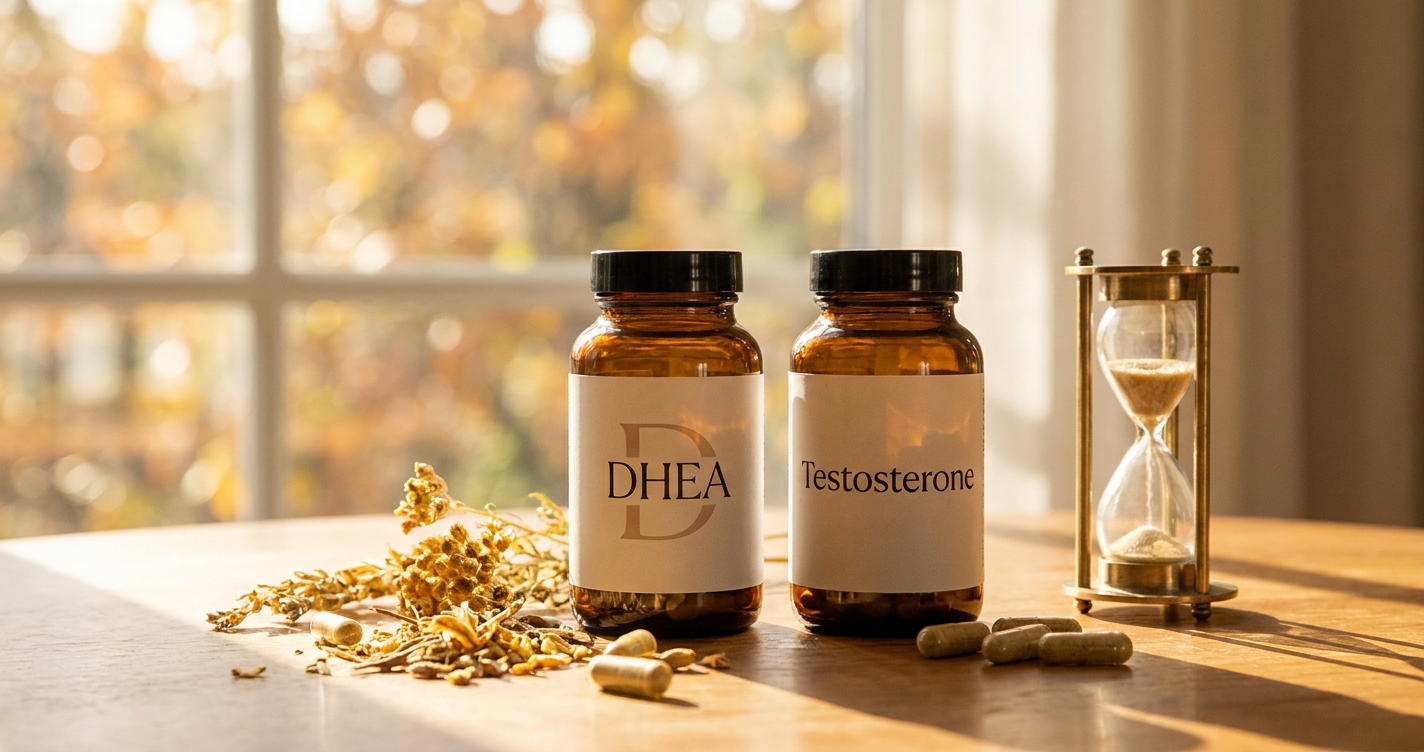
DHEA is everywhere in anti-aging and hormone optimization circles. It is called the “mother hormone” because it serves as a precursor to testosterone, estrogen, and several other steroid hormones. Supplement companies sell it as a testosterone booster. Athletes use it. Men over 40 talk about it in forums.
But does it actually work for testosterone? The answer requires understanding how DHEA works in the body and who actually benefits.
What DHEA Is
DHEA (dehydroepiandrosterone) is a steroid hormone produced primarily by the adrenal glands. It is the most abundant circulating hormone in the human body. It serves as a biochemical raw material that tissues throughout the body convert into sex hormones — primarily testosterone and estrogen, depending on the tissue and the enzyme environment.
DHEA levels peak in your mid-20s and decline roughly 2% per year after age 30. By age 70, DHEA levels are typically 80-90% lower than they were at their peak. This decline is one of the reasons hormone optimization proponents are interested in supplementation.
The body converts DHEA to testosterone primarily in the testes, adrenal glands, and peripheral tissues. Whether that conversion actually produces meaningful testosterone increases depends on individual factors — age, enzyme activity, baseline hormone levels, and testicular function.
The Research on DHEA and Testosterone
The evidence on DHEA supplementation and testosterone is mixed, and the nuance matters.
A 2006 study published in the Journal of Clinical Endocrinology and Metabolism gave men 50mg of DHEA daily for 6 months. In men over 65, serum testosterone increased significantly — by an average of 20%. In younger men, no significant testosterone increase was observed. This age-related difference is important.
A 2013 systematic review in the Endocrine Society’s Journal of Clinical Endocrinology and Metabolism analyzed all available RCTs on DHEA and testosterone in men. The conclusion: DHEA supplementation increases serum DHEA-S (the sulfated form) but the effect on testosterone is inconsistent, with more pronounced effects in older men and less in younger men.
The likely explanation: in older men, the enzymatic conversion pathway from DHEA to testosterone becomes less efficient, but the capacity is still there. Adding more DHEA substrate drives more conversion. In young men with fully functional testicular hormone production, the pathway is already running at capacity, and adding DHEA does not push it further.
Who Benefits
Based on the research, DHEA supplementation for testosterone is most relevant for:
- Men over 50-60 with declining DHEA and testosterone — the age-related decline in DHEA is significant, and the conversion pathway is still functional
- Men with adrenal insufficiency — DHEA is produced primarily by the adrenal glands, and in men with adrenal insufficiency, DHEA levels are genuinely low
- Men with suboptimal testicular function — if the problem is upstream substrate supply (adrenal DHEA), supplementing the substrate may help
For young men with normal adrenal and testicular function, DHEA supplementation is unlikely to raise testosterone. The bottleneck is not substrate supply — it is the downstream enzymatic conversion or LH signaling.
Dosing and Forms
The research uses 25-100mg of DHEA daily. Most studies showing effects used 50mg daily. Higher doses (100mg+) do not appear to produce more testosterone and may increase estrogen.
DHEA comes in two forms: oral DHEA and DHEA-S (dehydroepiandrosterone sulfate). DHEA-S is the storage form that the body converts back to DHEA as needed. Most supplements use oral DHEA.
Start with 25-50mg daily if you are considering DHEA. More is not better — higher doses increase the risk of estrogen elevation without additional testosterone benefit.
The Estrogen Risk
This is the part that gets glossed over in supplement marketing: DHEA converts to both testosterone AND estrogen. In some men, particularly those with higher aromatase activity, the majority of supplemental DHEA gets converted to estrogen rather than testosterone.
Signs of excess estrogen from DHEA: water retention, nipple sensitivity, increased body fat, mood changes. If you notice these symptoms, stop DHEA immediately.
For men concerned about estrogen, adding DIM (diindolylmethane) alongside DHEA may help direct the conversion toward testosterone rather than estrogen. This is not well-studied, but the mechanism is biologically plausible.
DHEA and Testosil
Testosil does not contain DHEA. This is worth noting because some testosterone support supplements include DHEA — sometimes at excessive doses. Including DHEA without a clear need can lead to estrogen elevation without meaningful testosterone benefit.
If you are taking Testosil and want to add DHEA, it should be for a specific reason (age-related decline confirmed by blood work, adrenal insufficiency, etc.) and under the guidance of a healthcare provider who can monitor your hormone levels.
The Bottom Line
DHEA is not a universal testosterone booster. It raises testosterone most consistently in men over 50 with age-related decline. For young men with normal hormone production, the evidence is weak to nonexistent.
If you are over 50 and your DHEA-S levels are low (blood test can confirm), 25-50mg of DHEA daily is a reasonable intervention with a reasonable evidence base. Have your hormone levels monitored — both testosterone and estrogen — while supplementing.
If you are under 40 with normal hormone levels, DHEA supplementation is unlikely to help and may cause estrogen elevation. The money is better spent on zinc, vitamin D, and the evidence-backed herbal stack.